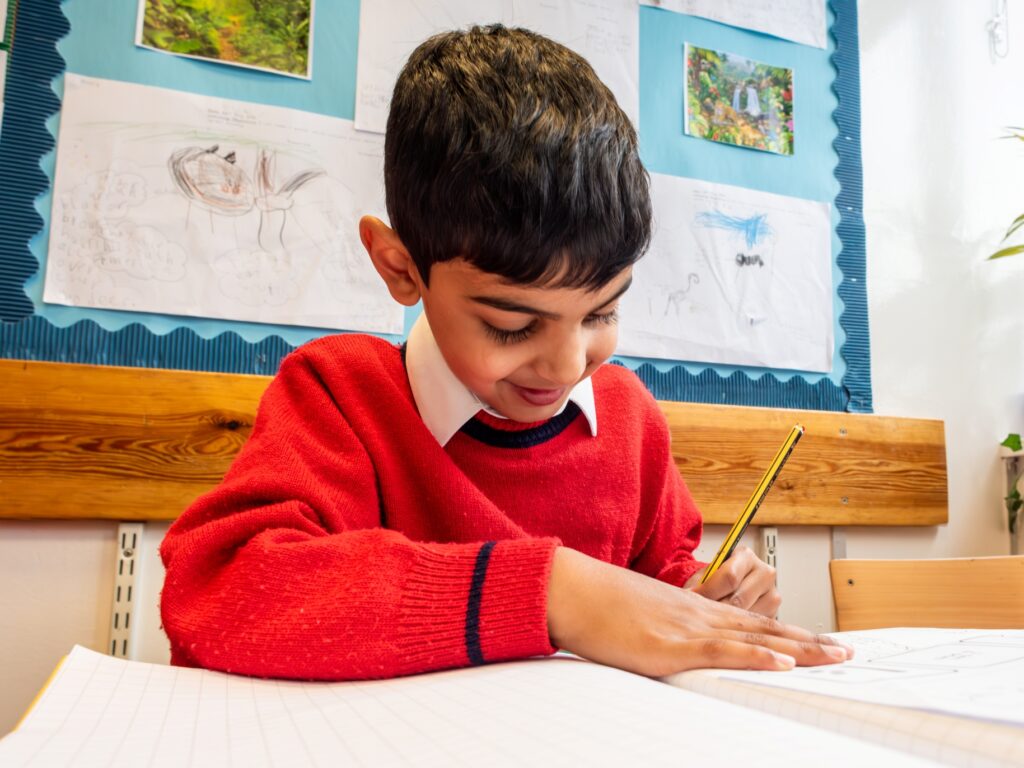
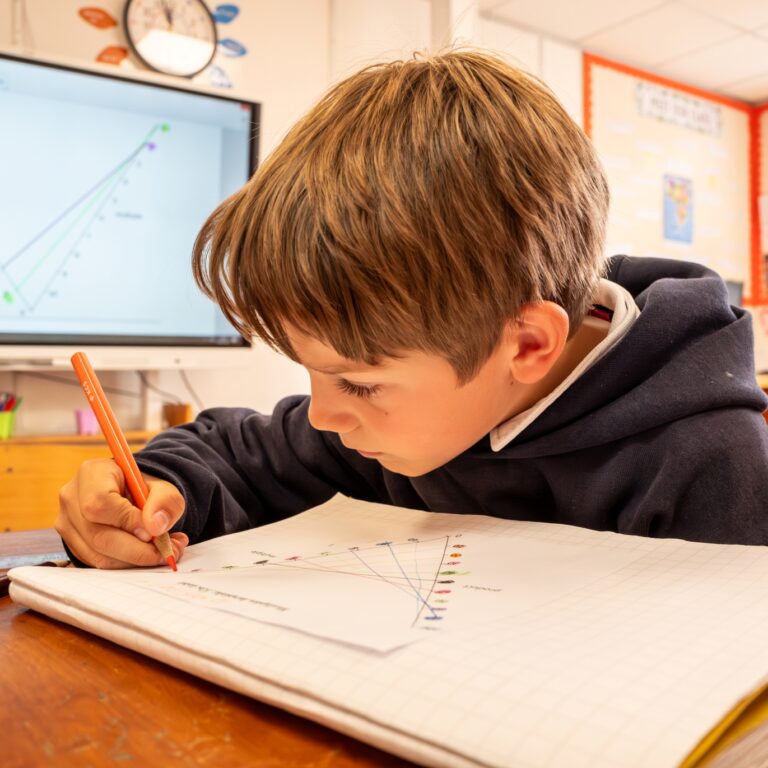
Child wearing a blue sweater writes with a pencil at a desk in a classroom, grid paper in front and colorful materials in the background

Spanish

Our unique Spanish immersive afternoons offer a dynamic, real-world approach to language learning, where children are taught a wide range of subjects from science and geography to art and sport in Spanish.

Spanish is embedded naturally across the curriculum while maintaining strong foundations in core subjects taught in English.

How does it work?

English in the morning

From Reception all the way through to Year 6,the four core 11+ subjects are all taught in English. This means that our morning teaching largely happens in English. The subject English (which includes Literacy and Phonics), Maths, Verbal Reasoning and Non-verbal Reasoning are all taught in keeping with the National Curriculum and in preparation for 11+ senior school entrance examinations.
Outside of those four core 11+ subjects, most other lessons are taught in Spanish.

Spanish in the afternoon

History, Geography, Computing, Religious Studies and Sport are all taught in Spanish.  Our immersive Spanish afternoons go above and beyond traditional second language teaching in a primary setting.  They offer your child the chance to work towards bilingualism from an early age.

Praise from the Spanish Embassy

We are delighted to report that our approach to Spanish language learning has the approval of the Spanish Embassy in London. In 2025, the Spanish Embassy’s education advisor, María Luisa Martínez, said that “The Roche School stands out as a remarkable institution” and that the “dedication and excellence of the teaching staff [is] evident in their well-prepared and engaging lessons, filled with creative topics that genuinely captivated the students.” Ms Martinez was impressed by our pupils’ “high level of Spanish, as they confidently followed the lessons in the language.”

University College London researchers have also been studying how the impact of bilingual learning has impacted our pupils.


Gaining a qualification in Spanish

By the time pupils are in Year 6, children demonstrating a high level with Spanish will be invited to prepare for the international A1 DELE exam for young learners if they are ready to do so. This is the first level of the Diplomas de Español como Lengua Extranjera (DELE) examinations offered by the  Instituto Cervantes on behalf of the Spanish Ministry of Education and Vocational Training.

A young girl with long curly hair in a red sweater sits at a table in a classroom, looking thoughtful with a notebook in front of her.

Spanish is for everyone

What if your child has no prior knowledge of Spanish, or your family has no connection to the Spanish language? Well, then, your child will be in good company. You may be interested to learn that many families who choose the Spanish immersive experience for their children have no prior links to Spanish. They recognise the benefits of bilingual learning and want to give their child the advantage of Spanish proficiency at an early age.

Our results show that children who have benefited from the Spanish immersive experience enjoy the same high level of results in English phonics, spelling, reading and writing as their peers. There is no downside to pursuing the Spanish immersive option: only upside.

What are you waiting for?

“The Spanish input at The Roche School is very organic and weaved into the timetable. Our daughter has built up a solid understanding of spoken Spanish and she has developed a lovely Spanish accent! Learning Spanish has proved to be the best decision for her.”   Roche School Parent
“Me gusta aprender ciencias, geografía e historia en español. ¡Hablamos español todos los días!” Roche School Pupil

FAQs

How much of the curriculum is taught in Spanish?

The Spanish immersion classes hold morning lessons (Maths and Literacy) in English. Afternoons involve British Curriculum-based lessons taught in Spanish wherever possible. The lessons we deliver in Spanish include Art, History, Geography, Computing and Science.

Is The Roche School suitable for children who do not speak Spanish at home?

Absolutely! We have no language requirements for pupils or parents. We recognise that all children have unique backgrounds and that they may not have had access to Spanish previously. Initially, the focus is on simple communication with gesture, song and pictures, and on classroom vocabulary. We regularly assess the children’s Spanish levels to meet their needs.

Will learning in two languages affect my child’s English development?

The research shows that being exposed to more than one language has a positive impact on the brain.

Do pupils achieve fluency in Spanish?

The aim is to expose the pupils to Spanish as much as possible, whilst being aware that they will not become fluent due to our context.

Who teaches the Spanish elements of the curriculum?

Pupils are taught by one of our experienced teachers with in-depth Spanish knowledge.

How does being a Spanish bilingual school in London benefit children?

The majority of our children have no prior knowledge of Spanish. Their parents recognise the numerous benefits of being exposed to a foreign language from an early age as it:

  • Advances children academically
  • Brings cognitive advantages
  • Encourages a global outlook and open-mindedness
  • Enhances communication skills
  • Is fun to learn and speak another language!
Great News!

Wow! Over a third of our incredible Year 6 cohort have won Academic scholarships at 11plus. What a result!

Spanish Taster Session for 4s and under on Friday 22nd May 9.30am-10.30am

Summer Science Taster Session for 4s and under on Tuesday 16th June 9.30am-10.30am

School tours on Monday 8th June 9.30am-10.30am and Wednesday 1st July 9am-10am